| Getting your Trinity Audio player ready... |
Tracking HVAC marketing benchmarks helps reduce wasted spend, anticipate seasonal shifts, and allocate budget more effectively. These insights optimize channel mix, improve profitability per lead, and support predictable revenue growth.
TL;DR — What You Need to Know About HVAC Marketing Benchmarks
HVAC marketing benchmarks are the performance standards used to evaluate how efficiently your business generates leads, converts them into sales, and retains customers compared to competitors in your market.
Key HVAC marketing benchmark ranges for 2026:
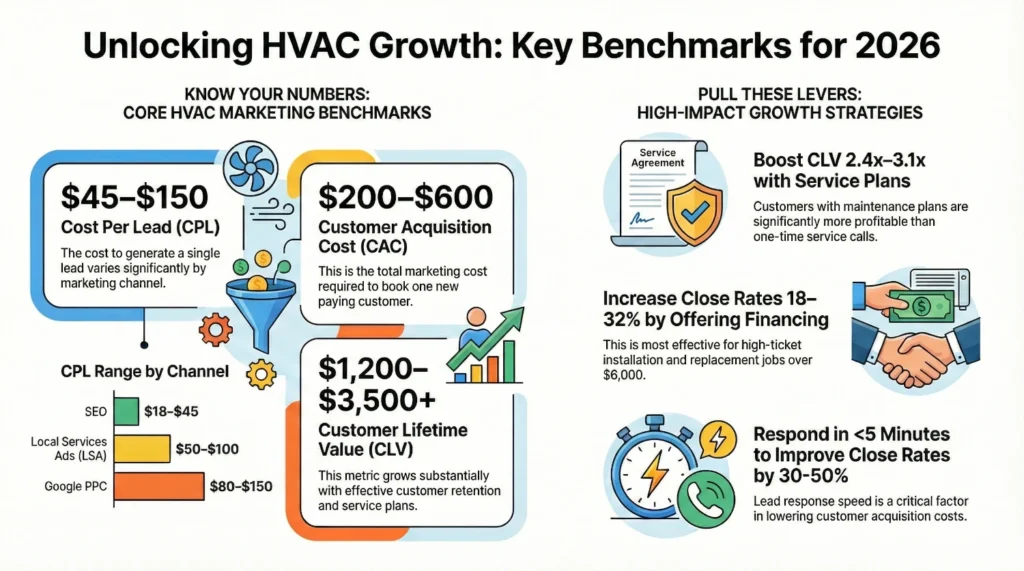
- Cost per Lead (CPL): $45–$150 depending on channel and city size
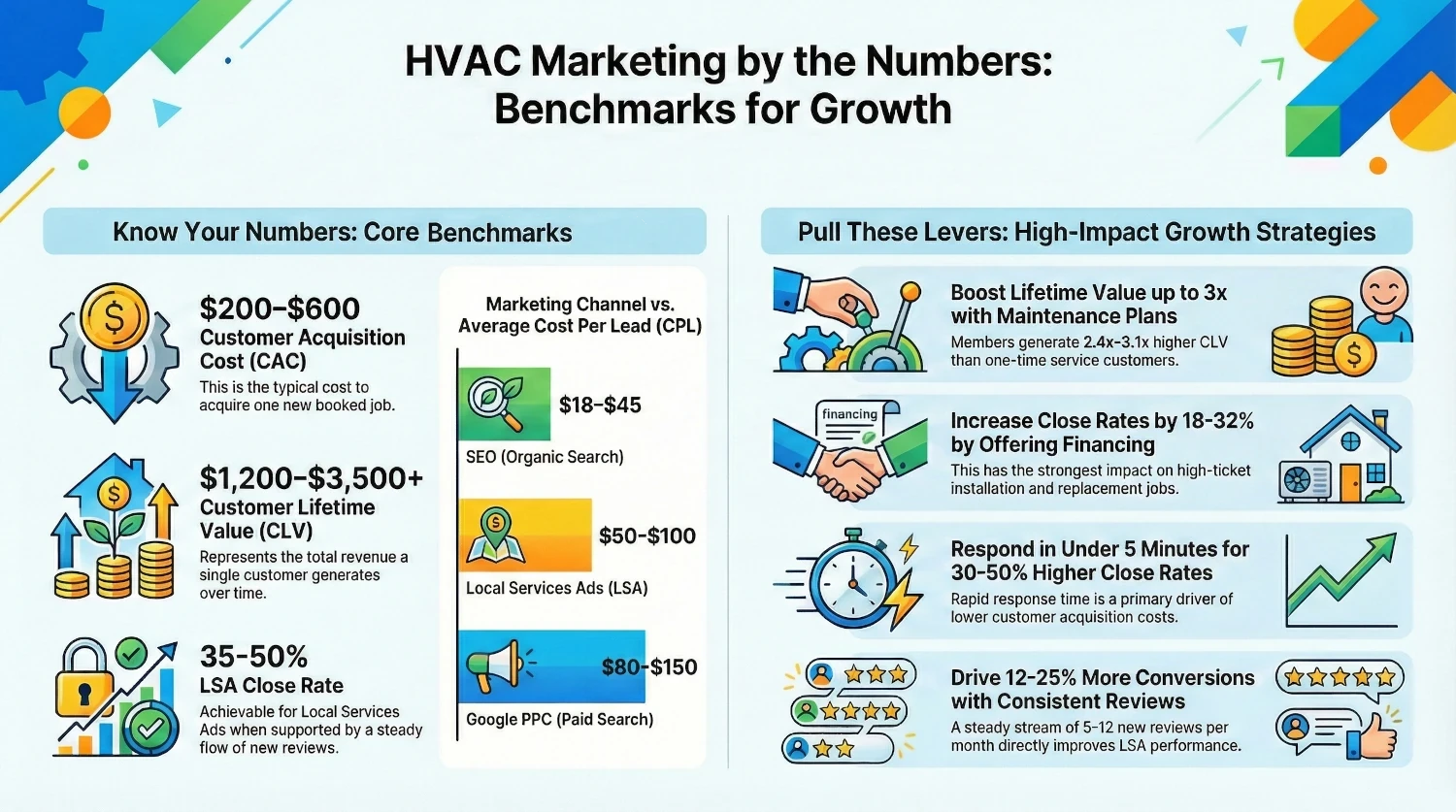
- Customer Acquisition Cost (CAC): $200–$600 per booked job
- Customer Lifetime Value (CLV): $1,200–$3,500 (higher with service plans + retention)
- Conversion Rate: 3–12% depending on intent and landing page quality
- Cost per Click (CPC): $3–$12 based on city size and season
- LSA Close Rate: 35–50% when supported by consistent review velocity
- Net profit margin: 8%
What HVAC Marketing Benchmarks Are (and Why They Matter in 2026)
HVAC marketing benchmarks represent reference metrics derived from aggregated performance data across campaigns, channels, and regions. These benchmarks allow HVAC companies to evaluate whether their HVAC marketing performance is underperforming, average, or ahead of market conditions.
In 2026, performance benchmarks play a direct role in forecasting seasonal demand spikes. Cooling demand peaks now arrive earlier in several U.S. regions, while heating-related inquiries show shorter decision windows. These indicators help teams allocate budgets ahead of demand shifts rather than reacting after acquisition costs increase.
The HVAC sector remains one of the most competitive local service categories. Increased franchising, private equity consolidation, and national advertising budgets place additional pressure on independent contractors. Performance benchmarks across lead acquisition and revenue efficiency provide a reference point for CAC, CPL, ROI, and ROAS, allowing smaller operators to identify where operational efficiency offsets scale disadvantages.
Data from 2024–2025 differs significantly from earlier periods. CPC volatility increased, LSA lead quality became more review-dependent, and organic traffic distribution shifted toward service-specific pages. These changes directly affect HVAC marketing performance and reinforce the need for updated benchmarks rather than legacy averages.
Must-Track HVAC Marketing Benchmarks for Real Business Growth
HVAC Industry Snapshot 2026 — Fast Facts (Real Numbers)
Across the U.S., aggregated market performance data indicates the following median ranges:
| Metric | Typical Benchmark Range (U.S.) | Why It Matters |
| Average HVAC CPL | $25–$120 depending on channel | Identifies true cost of demand |
| Customer Acquisition Cost (CAC) | Often $300–$1,200+ | Determines budget required to scale |
| Customer Lifetime Value (CLV) | $2,500–$10,000+ for service companies | Drives long-term planning |
| Average PPC ROAS | Frequently 2.5x–5.2x | Shows how effectively paid traffic converts |
| Average Monthly SEO Traffic | Varies from 350 to 7,000+ depending on city size | Reveals organic demand potential |
| Repeat Customer Rate | 18%–42% | Indicates success of retention strategy |
| Lead Conversion Benchmarks | Landing Pages: 8–15% Calls: 18–35%+ Forms: 3–8% Chat: 5–12% Estimate Requests: 25–45% | Highlights channel behavior |
1. Cost & ROI Benchmarks
Average HVAC CPL by Channel (SEO, PPC, LSA, Social, Aggregators)
Industry marketing benchmarks show clear variation by channel. Organic search remains the lowest-cost source over time, while PPC and LSAs fluctuate sharply during seasonal demand surges.
| Channel | Typical CPL Range |
| SEO | $18–$45 |
| Google PPC | $80–$150 |
| Local Services Ads (LSA) | $50–$100 |
| Paid Social | $25–$85 |
| Lead Aggregators | $65–$140 |
Improve Customer Lifetime Value (CLV) Through Seasonal Retention
CLV growth remains one of the most underutilized levers in HVAC marketing. Benchmarks show that maintenance plan members generate 2.4x–3.1x higher lifetime value than one-time service customers. Seasonal follow-ups, inspection reminders, and priority scheduling directly influence repeat booking rates.
Retention-focused HVAC marketing solutions reduce dependency on peak-season lead acquisition while stabilizing revenue across off-season months.
Lower CAC Without Cutting Marketing Budget
Reducing CAC does not require lowering spend. HVAC marketing benchmarks show that CAC decreases primarily through operational improvements rather than budget cuts. Companies that respond to new leads within 5 minutes achieve 30–50% higher close rates compared to those responding after 30 minutes or more, directly lowering effective acquisition cost.
Lead qualification also plays a measurable role. Benchmarks indicate that HVAC businesses using CRM-based lead scoring, automated call routing, and same-day follow-ups reduce CAC by 15–25% by eliminating wasted spend on unbooked or poorly handled inquiries.
Lower CAC consistently correlates with disciplined tracking of lead source, response time, booking outcome, and revenue per lead. In contrast, teams focused only on impressions or clicks often see rising CAC despite stable traffic volume.
Track True ROI (Not Vanity Metrics)
Clicks, impressions, and sessions do not reflect revenue impact. Overall marketing effectiveness improves when ROI calculations include closed revenue, margin, and service mix. Attribution models that connect calls and form fills to invoices provide clearer insight into which channels sustain profitability.
Profit Optimization: Upsells, Memberships & Annual Maintenance Plans
| Metric | Benchmarks | Revenue Impact |
| CLV Increase from Maintenance Plans | +25–45% | Higher lifetime revenue and reduced churn |
| Maintenance Membership Conversion Rate | 12–25% after repair visits | Stabilizes off-season booking volume |
| Upsell Revenue per Job | +8–18% incremental revenue | IAQ products, safety checks, efficiency upgrades |
| Customer Churn Impact | Lower churn vs one-time service customers | Improves revenue predictability |
| CAC Reduction Over Time | Declines with repeat customers | Less reliance on paid acquisition |
Upsells, membership programs, and annual maintenance agreements significantly increase lifetime revenue and stabilize off-season demand. Performance data shows that service companies with structured maintenance plans achieve 25–45% higher CLV, lower churn, and more predictable booking volume throughout the year.
Maintenance memberships typically convert 12–25% of customers after a repair visit, and upsells related to safety checks, IAQ products, or system efficiency updates add 8–18% incremental revenue per job. These programs reduce CAC over time because repeat customers require no additional acquisition spend, supporting higher margin performance.
When HVAC businesses build upsell paths into technician workflows and follow a consistent seasonal outreach calendar, profitability rises even when lead costs increase.
2. Sales Cycle & Revenue Growth Indicators
Average Lead-to-Close Time in HVAC
Lead-to-close time varies by service type. Emergency repairs often close within 24–72 hours, while replacement projects extend from 7 to 21 days. HVAC marketing performance improves when messaging aligns with urgency level and decision complexity.
Reduce Lost Leads With Automation & AI Call Routing
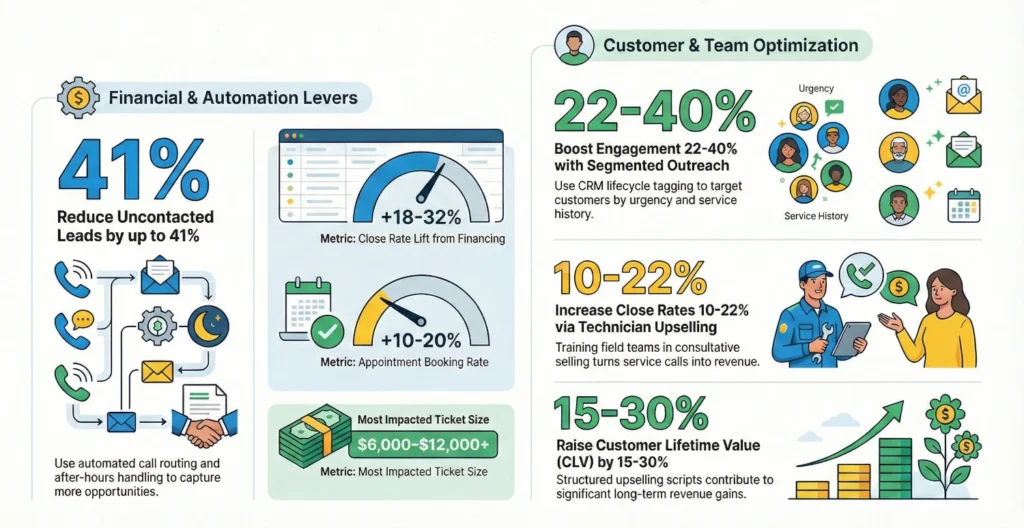
Missed calls remain a leading cause of lost revenue. Benchmarks show that automated call routing and after-hours handling reduce uncontacted leads by up to 41%. Faster response improves close rates regardless of channel source.
Financing Impact: How It Increases Close Rate by 18–32%
| Metric | Benchmarks | Impact on Results |
| Close Rate Lift from Financing | +18–32% | Strongest effect on installs and replacements |
| Ticket Size Sensitivity | $6,000–$12,000+ | Financing impact increases as ticket size rises |
| Appointment Booking Rate (Financing Messaging) | +10–20% | Higher engagement when financing is shown early |
| Best-Performing Assets | Approval-focused ads and landing pages | Improves lead qualification |
| In-Home Financing Effect | Higher conversion consistency | Reduces hesitation during peak seasons |
Financing availability strongly influences close rates for installation and replacement projects. HVAC marketing benchmarks show that offering structured payment plans increases close rates by 18–32%, especially on tickets above $6,000–$12,000. Campaigns that highlight financing early in the sales journey generate higher engagement and more qualified estimate requests.
Approval-focused ads and landing pages typically produce 10–20% higher appointment booking rates, while in-home financing discussions raise conversion consistency during peak replacement seasons. This uplift directly enhances marketing results in the HVAC sector, because monthly-payment framing reduces hesitation and accelerates decision-making for homeowners comparing multiple providers.
CRM Lifecycle Tagging for Peak/Off-Season Demand
Lifecycle tagging helps segment prospects by urgency, system age, and service history. When used consistently, industry marketing benchmarks show that segmented outreach delivers 22–40% higher engagement rates and 12–25% higher booking rates compared to generic service campaigns. Companies that adjust messaging for peak and off-season cycles enhance marketing results by prioritizing high-intent groups while nurturing long-term replacement opportunities.
Training Techs for Consultative Upselling (Data-Backed)
Technician interaction remains one of the strongest revenue drivers. Benchmarks indicate that field teams trained in consultative upselling contribute to 15–30% higher CLV and increase close rates by 10–22% during replacement and improvement projects. Structured scripts, option sheets, and follow-up routines help transform routine service calls into predictable revenue lifts, strengthening overall revenue efficiency and lead monetization outcomes.
3. HVAC Paid Advertising Benchmarks (CPC, CTR, Conversion Rate)
CPC Trends by State & City Size
CPC ranges reflect competition, population density, and seasonal weather patterns. HVAC marketing benchmarks typically show the following ranges:
| Market Size | CPC Range |
| Small towns (under 50K population) | $6–$14 |
| Mid-sized cities (50K–250K) | $10–$22 |
| Large metro areas (250K–1M+) | $18–$42 |
| Major competitive metros | $30–$55+ |
CTR Benchmarks for Emergency vs Non-Emergency Queries
CTR patterns show clear variation based on search intent.
Emergency HVAC queries typically generate 6.5–12% CTR, driven by urgency and immediate service needs.
Non-emergency service and research queries average 3–6% CTR, reflecting longer consideration paths and comparison behavior.
Separating emergency and non-emergency intent at the campaign level improves HVAC marketing performance by aligning ad messaging, bids, and landing pages with user readiness to act instead of blending fundamentally different search behaviors.
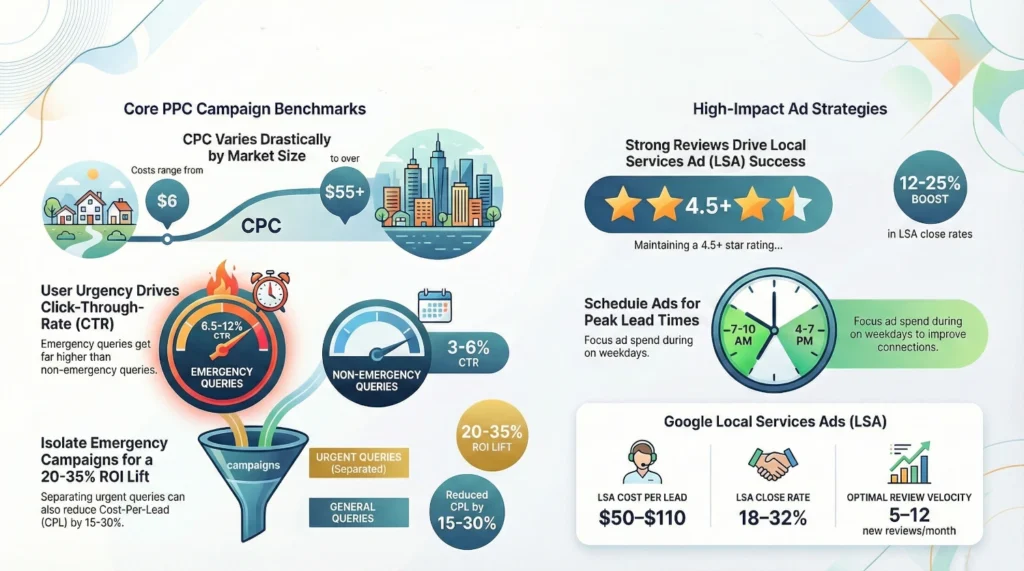
| Metric | Emergency | Non-Emergency |
| CTR | 6.5–12% | 3–6% |
| Conversion rate | 25–50% | 8–18% |
| Close rate | High | Medium |
| Sales cycle | 0–3 days | 7–21 days |
| Price sensitivity | Low | High |
| Best channels | LSA, Call-Only PPC | SEO, Search, Content |
LSA Benchmarks (Lead Cost, Close Rate, Review Impact)
HVAC industry benchmarks show that Google Local Services Ads performance is closely tied to review volume and rating. Typical LSA lead cost for HVAC ranges between $50–$110, depending on market competition and service type. Companies with optimized profiles and strong review activity consistently stay in the lower end of this range.
Close rates from LSA leads average 18–32%, with higher conversion observed for emergency and replacement-related calls.
Review strength plays a direct role: businesses maintaining a review velocity of 5–12 new reviews per month and an average rating above 4.5 stars see 12–25% higher close rates and improved ad visibility.
These benchmarks confirm that review volume, rating consistency, and ongoing activity function as both ranking and conversion drivers within LSA, directly influencing lead quality, close rates, and revenue efficiency.
| Metric | HVAC Benchmarks |
| LSA Cost per Lead (CPL) | $50–$110, varies by market competition and service type |
| LSA Close Rate | 18–32%, higher for emergency and replacement-related calls |
| Optimal Review Rating | 4.5+ stars average |
| Review Velocity | 5–12 new reviews per month |
| Close Rate Lift from Strong Reviews | +12–25% compared to low-review profiles |
| Visibility Impact | Higher review volume and recency correlate with improved LSA ranking and impression share |
Peak-Hour Ad Scheduling (Based on HVAC Lead Behavior)
Call data shows peak inquiry windows between 7–10 AM and 4–7 PM on weekdays. Scheduling HVAC ads around these windows improves connection rates and reduces wasted spend.
Smart Use of Call-Only & Emergency Campaigns
Call-only campaigns perform best during high-urgency conditions, typically generating 8–15% CTR and 30–50% conversion rates when triggered by emergency intent. HVAC marketing benchmarks show 20–35% higher ROI when call-only and emergency campaigns are isolated from broader keyword sets, reducing CPL by 15–30% compared to blended search campaigns.
High-Intent PPC Keyword Groups With Best ROI (2025-2026)
Certain keyword groups consistently demonstrate stronger marketing results in the HVAC sector.
| Keyword Type | Examples |
| Emergency | “ac repair now”, “furnace repair near me” |
| Replacement | “ac installation”, “heat pump replace” |
| Commercial | “commercial HVAC repair”, “rooftop unit service” |
| Financing | “ac financing”, “HVAC payment plans” |
4. HVAC SEO & Organic Search Opportunity Benchmarks
Top Volume HVAC Keywords (2025 Edition)
Service-specific keywords continue to dominate organic traffic. Installation, repair, and maintenance queries remain the primary drivers. Performance data highlights the declining value of broad informational keywords that lack direct service context.
| Keyword | Metrics |
| hvac | Volume: 218,000 Difficulty: 76 Traffic Potential: 30,000 |
| hvac installation | Volume: 100,000 Difficulty: 18 Traffic Potential: 700 |
| hvac near me | Volume: 79,000 Difficulty: 12 Traffic Potential: 95,000 |
| hvac replacement | Volume: 71,000 Difficulty: 16 Traffic Potential: 79,000 |
| ac repair near me | Volume: 140,000 Difficulty: 36 Traffic Potential: 54,000 |
| air conditioner | Volume: 132,000 Difficulty: 69 Traffic Potential: 64,000 |
| air conditioning repair | Volume: 94,000 Difficulty: 22 Traffic Potential: 28,000 |
High-Value Money Keywords (+ Cost per Rank)
Cost per Rank reflects the estimated monthly investment required to reach and maintain a top-10 or top-3 organic position. It is based on keyword difficulty, competitive link velocity, and ongoing content and optimization costs. HVAC marketing benchmarks use cost per rank to compare long-term SEO investment against recurring PPC spend.
| Keyword | Difficulty | Volume | Intent Profile | Estimated Cost per Rank (Monthly) |
| carrier | 62 | 52,000 | Branded | $700–$1,200 |
| hvac services | 39 | 49,000 | Commercial | $400–$700 |
| hvac meaning | 56 | 45,000 | Informational (High CPC) | $500–$900 |
| heating repair | 40 | 23,000 | Commercial + Transactional | $350–$600 |
| furnace installation | 42 | 14,000 | Transactional | $450–$800 |
| commercial hvac | 45 | 9,900 | Commercial | $500–$900 |
| residential hvac | 38 | 2,400 | Commercial | $300–$550 |
| ductwork repair | 32 | 1,400 | Service-Focused | $250–$450 |
Cost-per-rank analysis often delivers stronger long-term ROI than paid acquisition, as organic positions continue generating leads without incremental cost per click. Higher-difficulty branded and commercial keywords require larger upfront investment, while service-focused terms reach profitability faster due to lower competition and clearer intent.
Local Search Behavior & Micro-Intent Patterns
Local search behavior increasingly reflects micro-intents tied to specific system conditions and homeowner concerns, such as system age, unusual noise, or rising energy bills. Marketing effectiveness in the HVAC industry increases when local landing pages and service content address these patterns directly rather than relying on generic service messaging.
HVAC marketing benchmarks reveal that users increasingly search with micro-intent language that specifies problem symptoms, budget considerations, or timeframe expectations. Examples include:
- “AC leaking water”
- “HVAC making noise”
- “How much to replace furnace”
- “HVAC tune-up near me today”
These patterns influence HVAC marketing performance because micro-intent often precedes direct service contact. Content that answers these questions accurately supports higher conversion rates.
City + Service Page Matrix (How Many Pages You Need)
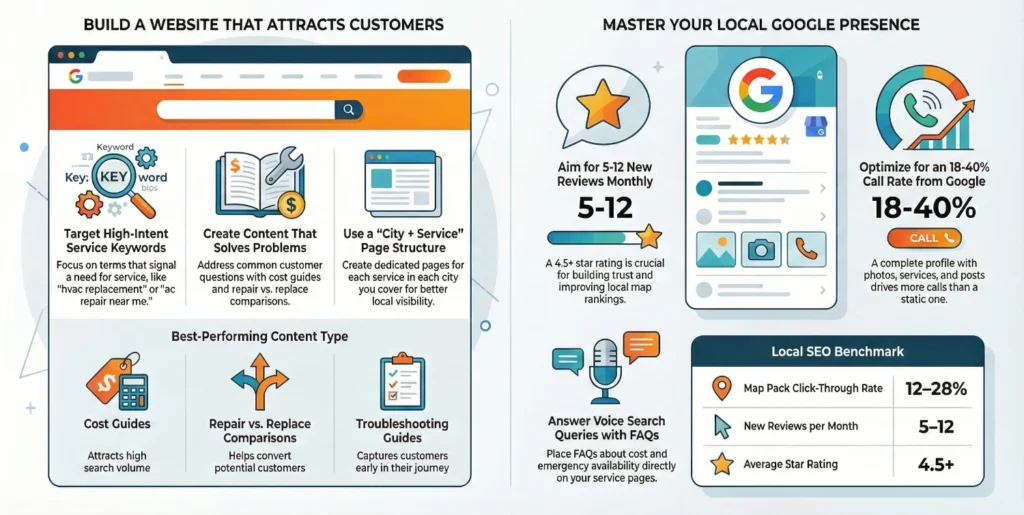
Performance analysis shows that scalable local growth requires a structured city + service page matrix rather than a single catch-all location page. In most markets, companies need one core service page per primary service and 5–20 city or service-area pages per metro, depending on competition and geographic coverage.
For multi-service HVAC businesses, this typically results in 15–60 indexed pages to achieve consistent map pack and organic visibility across neighborhoods. Benchmarks indicate that deeper coverage directly improves local rankings and call volume, while thin or consolidated pages limit reach in competitive areas.
Best-Performing Content Types for SEO (Data-Based)
Several content formats consistently outperform others in organic search and deliver measurable performance gains:
| Content Format | Performance Advantage |
| Cost guides | High search volume |
| Repair vs replace comparisons | Strong assist-to-conversion |
| Seasonal checklists | Supports retention |
| Warranty and lifespan topics | Trust-building |
| Troubleshooting content | Early intent capture |
Voice Search HVAC Queries & FAQ Optimization
Voice search queries in HVAC are highly intent-driven and focus on immediacy, availability, and problem symptoms. HVAC marketing benchmarks show that common voice-style queries include phrases such as:
- “Why is my AC blowing warm air?”
- “Who does AC repair near me right now?”
- “How much does it cost to replace a furnace?”
- “Is there emergency HVAC service open today?”
FAQ sections perform best when placed directly on service pages, city/service-area pages, and Google Business Profile (GBP) profiles rather than generic blog posts. Benchmarks indicate that well-structured HVAC FAQs increase featured snippet visibility and contribute to 10–20% incremental organic traffic from long-tail and voice-driven searches.
Companies that align FAQ content with real service questions such as pricing, timelines, emergency availability, and replacement decisions strengthen overall marketing effectiveness by capturing demand earlier in the decision process without weakening commercial intent.
Local SEO Benchmarks (GBP, Reviews, Call Rate, Map Pack CTR)
| Metric | Benchmarks | Performance Impact |
| Map Pack CTR | 12–28% | Higher CTR associated with profile freshness and proximity relevance |
| Review Velocity | 5–12 new reviews per month | Sustains map visibility and ranking stability |
| Average Rating Threshold | 4.5+ stars | Correlates with stronger trust and higher inbound call volume |
| Review Stagnation Window | 60–90 days without new reviews | Often followed by reduced map visibility and call decline |
| GBP Call-Through Rate | 18–40% | Varies by service urgency and profile completeness |
| Profile Engagement Factors | Photos, services, hours, posts | Higher engagement vs static listings |
Local visibility and lead volume are strongly influenced by Google Business Profile (GBP) optimization, review activity, and engagement signals.
In competitive HVAC markets, Map Pack CTR typically ranges from 12–28%, with higher performance tied to profile freshness and proximity relevance.
Review activity plays a measurable role. Businesses maintaining 5–12 new reviews per month and an average rating above 4.5 stars consistently outperform competitors with stagnant profiles. Benchmarks indicate that declining review velocity over 60–90 days often correlates with reduced map visibility and lower inbound call volume.
Call-through rate from GBP listings averages 18–40%, depending on service urgency and profile completeness. Listings with updated photos, service descriptions, operating hours, and recent posts generate higher engagement than static profiles. Together, these factors directly impact HVAC marketing performance by converting local search visibility into qualified inbound calls rather than impressions alone.
Internal Linking Structure for HVAC Sites (2026 Standard)
Internal linking supports user flow and search understanding by connecting service content in a logical pathway. HVAC marketing benchmarks show improved engagement when internal links are implemented based on:
- Problem → Solution → Estimate
- Repair → Replacement → Financing
- Seasonal tasks → Membership → Reminder
5. Competitive Insights (2026)
Major HVAC Brands Performance Breakdown
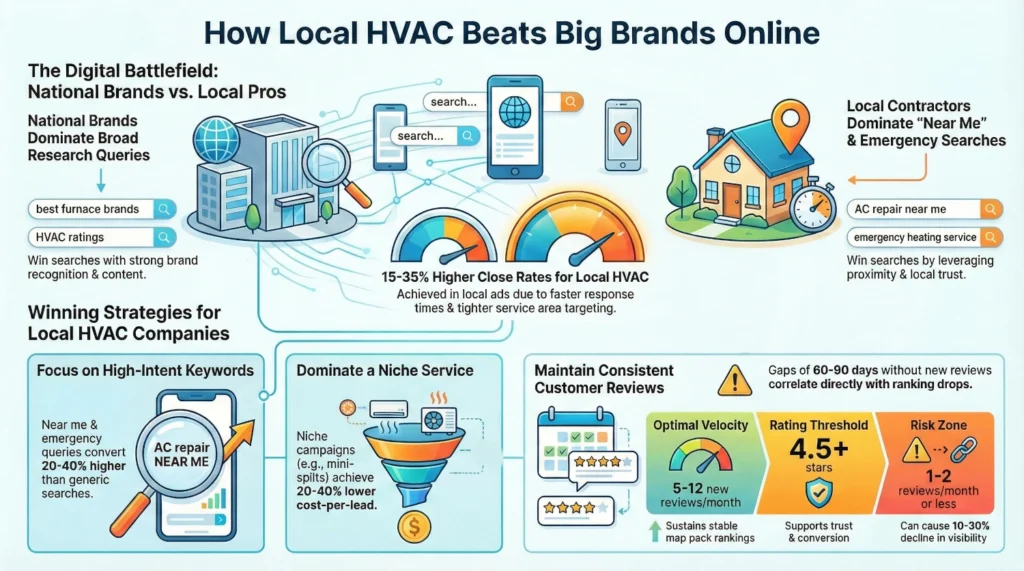
National HVAC brands such as Lennox, Carrier, and Trane dominate branded and research-driven search queries due to strong brand recognition, high domain authority, and extensive content libraries. Search behavior data shows that users frequently research topics such as “best furnace brands,” “heat pump efficiency,” and manufacturer comparisons at early decision stages. HVAC marketing benchmarks show that national brands consistently achieve top-3 organic visibility for these research-focused queries, capturing a significant share of upper-funnel demand before local service selection begins.
However, performance drops sharply in hyperlocal service queries. Observed market data shows that national brands appear in the local map pack for emergency and same-day searches in fewer than 20–30% of metro areas, while local contractors with optimized Google Business Profiles and service-area pages dominate terms such as “AC repair near me,” “no heat,” and “24/7 HVAC service.”
In paid channels, large brands primarily invest in upper-funnel PPC and display campaigns aimed at awareness and brand reinforcement. Local HVAC companies, by contrast, outperform national brands in Local Services Ads and emergency-focused PPC. Observed performance data shows that local operators achieve 15–35% higher close rates in these channels due to tighter service-area targeting, faster response times, and stronger localized trust signals. These gaps create clear opportunities for local HVAC businesses to compete by focusing on niche services, emergency response, and neighborhood-level SEO rather than attempting to match national brand budgets.
How Local HVAC Companies Beat Big Brands in SERP & LSA
Local HVAC companies outperform national brands in SERP and LSA by leveraging proximity signals, faster response times, and localized trust factors that large operators struggle to scale. HVAC marketing benchmarks show that local businesses appear in the map pack for emergency and “near me” queries 2–3× more often than national brands, particularly outside major downtown cores.
In Local Services Ads, proximity and review activity outweigh brand recognition. Benchmarks indicate that local HVAC companies with active profiles and steady review acquisition achieve 15–30% higher close rates than large brands running broad regional campaigns. Faster call response and tighter service-area focus further improve conversion efficiency.
By emphasizing neighborhood relevance, service specialization, and real customer feedback, local operators convert high-intent demand more effectively than national brands optimized primarily for scale rather than local execution. This advantage directly strengthens results in competitive markets.
Winning “Best”, “Near Me”, “Emergency” & “Vs” Queries
Comparison and urgency-driven queries consistently outperform generic service terms in conversion efficiency. HVAC marketing benchmarks show that “near me” and emergency queries generate 20–40% higher conversion rates than standard service searches due to immediate intent and proximity signals.
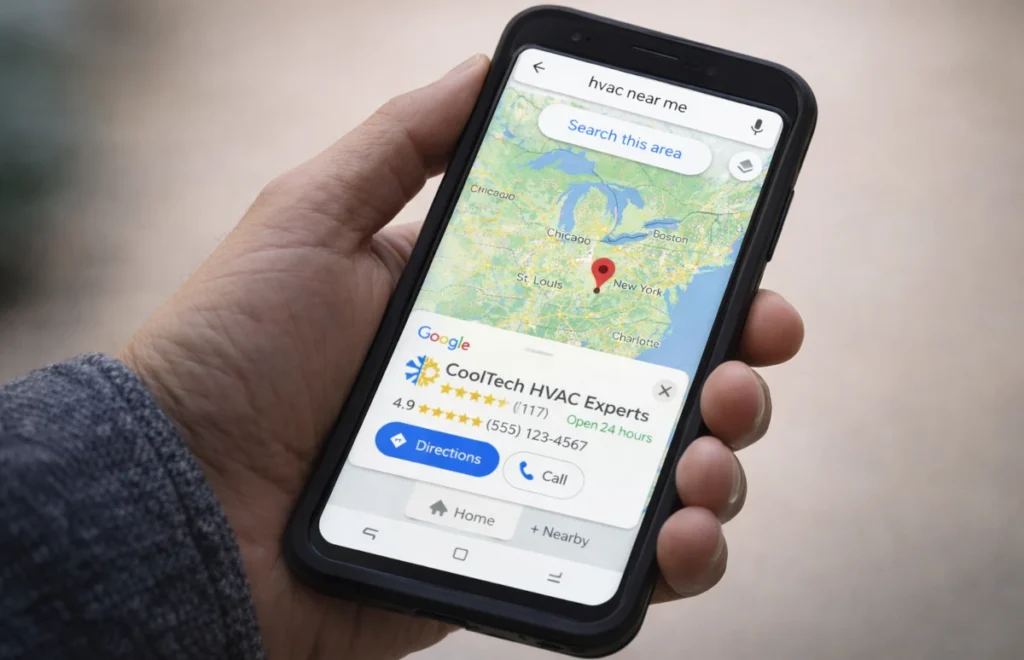
“Best” and “vs” queries, while lower in volume, deliver strong downstream value. Benchmarks indicate that comparison-based searches convert to booked estimates at 12–25%, especially when content clearly addresses pricing ranges, service differences, and real customer outcomes. These queries often precede replacement and upgrade decisions rather than same-day repairs.
HVAC companies that segment optimization strategies by intent—emergency, proximity, and comparison—achieve stronger marketing outcomes by aligning messaging, landing pages, and call handling with user readiness instead of treating all searches as equal.
Niche Dominance Strategy (Mini-Split, Heat Pumps, Commercial HVAC)
Focusing on niche HVAC services reduces competitive density and improves profitability by narrowing keyword pools and targeting higher-intent audiences. HVAC industry benchmarks show that niche-focused campaigns often achieve 20–40% lower CPL and 15–30% higher close rates compared to broad “full-service HVAC” positioning.
Mini-split and heat pump campaigns benefit from education-driven demand, rebate and efficiency messaging, and lower advertiser saturation, leading to 10–25% higher average job value. Commercial HVAC niches typically generate fewer leads but deliver 2–4х higher ticket sizes, improving margin efficiency even with longer sales cycles.
HVAC companies that build dedicated service pages, PPC campaigns, and case studies around a single niche consistently outperform generalists in both organic visibility and paid efficiency, strengthening overall marketing results in the HVAC sector.
Review Velocity Benchmarks & Impact on Rankings
| Metric | Benchmarks | Impact on Visibility |
| Optimal Review Velocity | 5–12 new reviews per month | Sustains stable map pack rankings and higher call-through rates |
| Average Rating Threshold | 4.5+ stars | Supports trust, conversion, and local ranking strength |
| Low Review Velocity Risk Zone | 1–2 reviews per month or less | Often followed by 10–30% decline in local visibility |
| Review Gap Warning Window | 60–90 days without new reviews | Correlates with ranking drops in map pack and LSA, especially in competitive markets |
| Ranking Stability Effect | Consistent review flow | Reinforces freshness and relevance for location-based searches |
HVAC industry benchmarks show that review velocity plays a direct role in local ranking stability and visibility. Businesses maintaining a consistent pace of 5–12 new reviews per month with an average rating above 4.5 stars sustain stronger map pack positions and higher call-through rates.
When review acquisition slows below 1–2 reviews per month for extended periods, benchmarks indicate a 10–30% decline in local visibility and reduced presence in LSA and map results, especially in competitive markets. Sudden review gaps lasting 60–90 days often correlate with ranking drops during peak demand seasons.
Consistent review velocity functions as both a freshness and trust signal, reinforcing relevance for location-based searches. HVAC companies that align review generation with completed jobs and seasonal volume maintain more stable rankings and stronger HVAC marketing performance over time.
Competitor-Intent Campaigns (SEO + PPC)
Competitor-intent campaigns target searches where users compare providers or reference specific HVAC brands, capturing demand at the final decision stage. HVAC marketing benchmarks show that competitor-focused queries convert 15–30% higher than generic service searches when messaging emphasizes clear differentiation rather than price matching.
In paid search, competitor-intent campaigns typically deliver 10–25% lower CPL than broad non-branded campaigns due to narrower targeting and higher intent. In organic search, comparison pages addressing “vs,” alternatives, and local advantages generate 12–20% higher conversion rates when they clearly outline response time, service scope, warranties, and customer experience.
The strongest marketing results in the HVAC sector come from positioning competitor-intent content around trust, speed, and local expertise instead of discounts, allowing businesses to influence buyers already evaluating multiple providers.
6. Content & Publishing Benchmarks for HVAC Companies
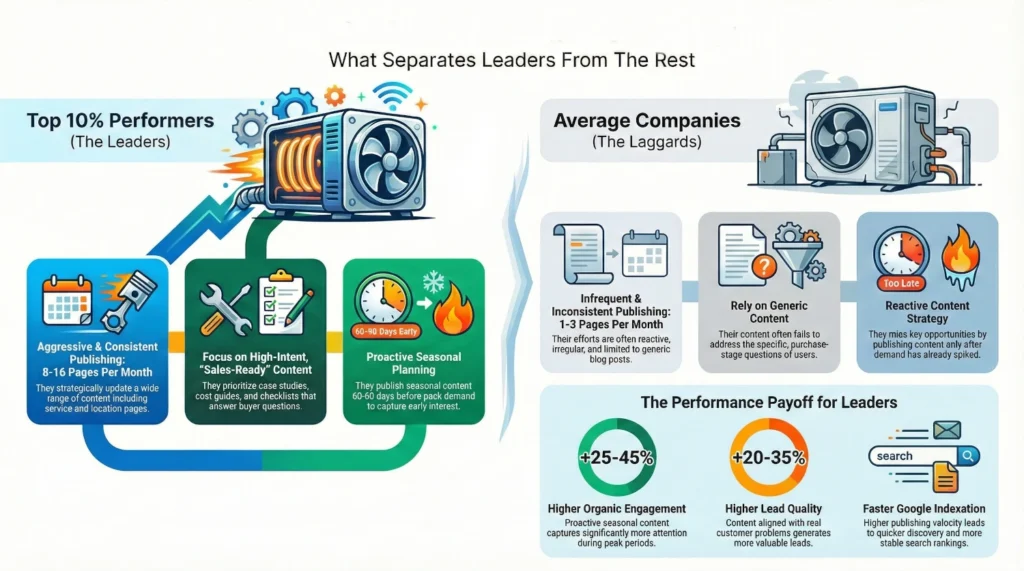
Publishing Velocity Benchmarks (Top 10% vs Average)
| Metric | Top 10% HVAC Companies | Average HVAC Companies |
| Monthly Publishing / Updates | 8–16 pages per month | 1–3 pages per month |
| Content Coverage | Service pages, location pages, FAQs, replacement content | Limited pages, often blog-only |
| Publishing Consistency | Structured, ongoing cadence | Irregular, reactive updates |
| Indexation Speed Impact | 30–60% faster indexation | Slower discovery and updates |
| Ranking Stability | More stable rankings during seasonal shifts | Higher volatility |
| Long-Term Visibility | Stronger retention of map and organic positions | Gradual visibility erosion |
Publishing velocity directly affects indexation speed, ranking stability, and long-term organic visibility. HVAC marketing benchmarks show a clear gap between average companies and top performers in content output and update frequency.
Top 10% HVAC companies typically publish or significantly update 8–16 pages per month, covering service pages, location pages, FAQs, and replacement content. Average companies publish 1–3 pages per month, often inconsistently and without a structured update cadence.
Benchmarks indicate that higher publishing velocity leads to 30–60% faster indexation, more stable keyword rankings during seasonal shifts, and stronger retention of map and organic positions. Companies that treat publishing as an ongoing operational process rather than a one-time SEO task consistently outperform slower publishers in overall results and visibility.
Best Performing Content Types (Case Studies, Cost Guides, Checklists)
Content tied directly to real sales conversations consistently outperforms generic blog posts. Performance data shows that case studies, cost guides, and diagnostic checklists generate higher engagement and conversion rates because they address purchase-stage questions.
Case studies typically convert at 10–20%, especially when they include project scope, pricing ranges, timelines, and location context. Cost and pricing guides produce 8–15% conversion rates, capturing high-intent users researching replacement or upgrade decisions. Diagnostic checklists and troubleshooting guides convert at 4–8%, but play a key role in nurturing demand and feeding replacement pipelines.
Benchmarks indicate that HVAC companies prioritizing these formats see 20–35% higher lead quality and more consistent close rates, as content aligns closely with how technicians and sales teams explain options during calls and estimates. This alignment directly improves overall HVAC marketing performance.
Predictable Publishing Schedules + Seasonal Planning
Predictable publishing schedules aligned with seasonal demand significantly improve visibility and engagement. Industry marketing data indicate that companies publishing seasonal content 60–90 days before peak demand achieve 25–45% higher organic engagement and stronger ranking stability during high-competition periods.
Top-performing HVAC companies plan content around heating and cooling cycles, releasing replacement, emergency, and pricing content ahead of extreme weather rather than reacting after demand spikes. Benchmarks indicate that proactive seasonal publishing leads to 15–30% higher lead volume during peak months compared to reactive content strategies.
Businesses that follow a consistent seasonal calendar—rather than irregular publishing—strengthen overall HVAC marketing results by capturing demand earlier, reducing reliance on paid channels during peak periods, and smoothing lead flow across the year.
| Metric | Benchmarks | Performance Impact |
| Publishing Lead Time Before Peak | 60–90 days | Captures demand before competition intensifies |
| Organic Engagement Lift | +25–45% | Higher visibility and interaction during peak periods |
| Lead Volume Impact (Peak Months) | +15–30% | Stronger inbound demand vs reactive publishing |
| Content Focus Areas | Replacement, emergency, pricing content | Aligns with high-intent seasonal queries |
| Publishing Cadence | Predictable seasonal calendar | More stable rankings and reduced paid dependency |
Turning Service Calls Into SEO Content (2026 Method)
| Metric | Benchmarks | Performance Impact |
| Organic Conversion Rate Lift | +20–35% vs generic blog content | Higher lead capture from problem-driven searches |
| Long-Tail Organic Traffic Growth | +15–25% | Stronger visibility for diagnostic and emergency queries |
| Primary Content Sources | Service logs, technician reports | Reflects real homeowner issues and intent |
| High-Performing Content Types | Common AC problems, repair vs replacement guides, location-specific issue pages | Aligns content with sales conversations |
| Publishing Frequency | Monthly review and content production | Sustains relevance and ranking consistency |
Service call logs and technician reports provide one of the most reliable sources of high-intent SEO content. Data from industry marketing indicate that pages built around real service issues—error symptoms, repair scenarios, and replacement triggers—achieve 20–35% higher organic conversion rates than generic blog content.
Top-performing HVAC companies regularly convert service data into SEO assets such as “common AC problems,” “repair vs replacement” guides, and location-specific issue pages. Benchmarks indicate that this method improves topical relevance and supports 15–25% growth in long-tail organic traffic, especially for emergency and diagnostic searches.
By systemizing this process through monthly review of service logs and publishing content based on real customer questions, HVAC companies strengthen relevance signals and improve HVAC marketing performance without relying on speculative keyword research.
Creating Expert Hubs & Service Clusters
Service clusters organize content around core HVAC topics such as AC, heating, IAQ, and ductless systems. HVAC marketing benchmarks show that websites using a clear hub-and-spoke structure achieve 25–45% higher organic visibility and 15–30% stronger conversion performance compared to flat sites built around disconnected blog posts.
Clustered architectures also improve crawl efficiency and topical authority. Benchmarks indicate faster indexation and more stable rankings when service pages, sub-services, and supporting content are internally linked around a single core topic rather than scattered across unrelated URLs.
A typical cluster may include:
- Main service pillar page
- Subpages for repair, installation, maintenance
- Supporting FAQs, comparisons, and troubleshooting guides
This structure helps search engines and users understand service depth, which directly supports stronger organic visibility and more consistent lead generation.
Repurposing Reviews Into Location-Based Case Studies
Customer reviews can be repurposed into location-based case studies by embedding real feedback directly into city pages, service-area pages, and replacement or repair landing pages. This includes quoting reviews that mention specific neighborhoods, service types, timelines, or outcomes, and pairing them with short context blocks explaining the job performed.
Pages that use repurposed reviews tied to a specific location or service see 12–28% higher conversion rates compared to pages with generic testimonials. Review-based case studies also strengthen local relevance signals, supporting improved map visibility and higher call-through rates from organic traffic.
Companies that systematically reuse reviews across multiple location and service pages strengthen trust, reduce hesitation, and improve conversion outcomes without creating new long-form content for each page.
Using Video in HVAC SEO & PPC Funnels
Video supports marketing results in the HVAC sector across multiple channels:
- On-site explainers increase time on page and trust
- Short clips can be used in paid campaigns and remarketing
- Walkthroughs and system tours support buying decisions
FAQs About HVAC Marketing Benchmarks
What are the core metrics HVAC companies must track in 2026?
Key HVAC marketing performance metrics for 2026 focus on profitability and conversion efficiency across the full sales cycle. Cost per lead (CPL) measures acquisition efficiency by channel, while customer acquisition cost (CAC) shows how much it costs to generate a paying customer. Customer lifetime value (CLV) indicates long-term revenue potential beyond a single job.
Revenue per lead and revenue per job connect marketing activity directly to income, helping identify which channels drive real value. Lead-to-close rate reflects sales effectiveness and follow-up quality, while call-through rate from map and local listings measures how well local visibility converts into inbound calls. Together, these metrics provide a complete view of marketing impact and guide smarter budget and growth decisions.
Why do HVAC companies see such large seasonal fluctuations in their marketing performance?
Seasonal fluctuations occur because HVAC demand is directly tied to temperature extremes, which compress service demand into short peak windows. During heat waves and cold snaps, emergency searches surge, increasing competition, CPC, and lead volume simultaneously. In mild seasons, demand shifts toward maintenance and research-driven queries, lowering urgency but extending decision cycles.
These patterns cause marketing outcomes in the HVAC space to fluctuate as CPL, close rates, and channel efficiency shift with weather-driven intent. Companies that plan campaigns, staffing, and budgets around seasonal demand capture more profitable work, while reactive strategies often experience higher costs and inconsistent results.
How can HVAC businesses lower their cost per lead without sacrificing quality?
SEO, LSAs, retargeting, and branded campaigns reduce reliance on high-cost keywords while preserving intent quality.
What marketing channels deliver the highest ROI for HVAC in 2026?
Organic SEO and Local SEO provide long-term efficiency, while PPC and LSAs capture immediate demand. Balanced channel mix delivers the strongest HVAC marketing performance.
How much should HVAC companies budget for marketing annually?
Benchmarks range from 6% to 12% of annual revenue, depending on growth stage and market density.
Why do some HVAC websites rank quickly while others take months?
Baseline authority, content depth, and local signals influence speed. HVAC marketing benchmarks highlight these variables.
What causes HVAC CPC and lead costs to surge unexpectedly?
Extreme weather, competitive bidding, and low quality scores increase costs. Monitoring benchmarks helps anticipate these spikes.
How can smaller HVAC companies compete with franchises and national brands?
Smaller HVAC companies compete by focusing on hyperlocal SEO, consistent review generation, and well-structured service pages. Strong local relevance, proximity signals, and fast response times help offset the scale advantages of national brands and improve visibility in high-intent searches.
What’s the ideal keyword strategy for emergency vs non-emergency HVAC services?
Emergency queries require immediacy-focused messaging, while non-emergency queries support education-driven content.
How often should HVAC companies refresh their content and landing pages?
Updates every 30–90 days maintain relevance during seasonal shifts.
Why do some HVAC businesses generate traffic but not leads?
Mismatch between intent, UX issues, and weak CTAs reduce conversion despite traffic volume.
Why HVAC Companies Trust Netrocket
Real Benchmark Data, Not Guesswork
Netrocket works with live lead volumes, CPC trends, and seasonal demand data to inform HVAC marketing decisions.
Built-for-HVAC Local SEO Expertise
The team focuses on local signals that shape HVAC marketing performance: service area coverage, structured service pages, optimized Google Business Profiles, and consistent reviews. Working with an experienced HVAC SEO agency helps companies move from ad-dependent lead flow to sustainable search visibility.
Funnels Focused on Revenue, Not Clicks
Netrocket structures funnels around real buying stages: calls, estimates, booked jobs, and repeat service. HVAC marketing solutions prioritize CLV and revenue per lead rather than surface metrics. This orientation ensures marketing work supports both short-term bookings and long-term customer relationships.
Full Transparency With Revenue Attribution
Reporting ties channel performance to pipeline value. Metrics such as revenue by channel, average job value by source, and close rate by campaign are central to decision-making. Clients can clearly see which efforts drive profitable growth and which require revision.
HVAC Case Studies With Predictable Growth
Netrocket’s ongoing work with HVAC firms shows consistent patterns: reduced CPL, stronger seasonal performance, and better lead quality from thoughtfully structured campaigns. These outcomes align with modern HVAC industry benchmarks and confirm that data-driven adjustments over time produce stable, repeatable growth.
Grow Your HVAC Business With a Data-Driven Partner That Delivers Results
Sustainable growth in 2026 depends on aligning strategy with real HVAC marketing benchmarks, disciplined tracking, and execution grounded in measurable outcomes. HVAC companies that treat marketing as a revenue system—not an expense—gain clearer control over CPL, CAC, CLV, and seasonal performance volatility.
Netrocket works as a data-driven growth partner for HVAC businesses, combining benchmark-based planning, local SEO execution, and performance-focused HVAC PPC campaigns. Our approach connects search visibility, inbound demand, and sales operations into a single measurable pipeline, helping HVAC companies move from inconsistent lead flow to predictable, scalable revenue.